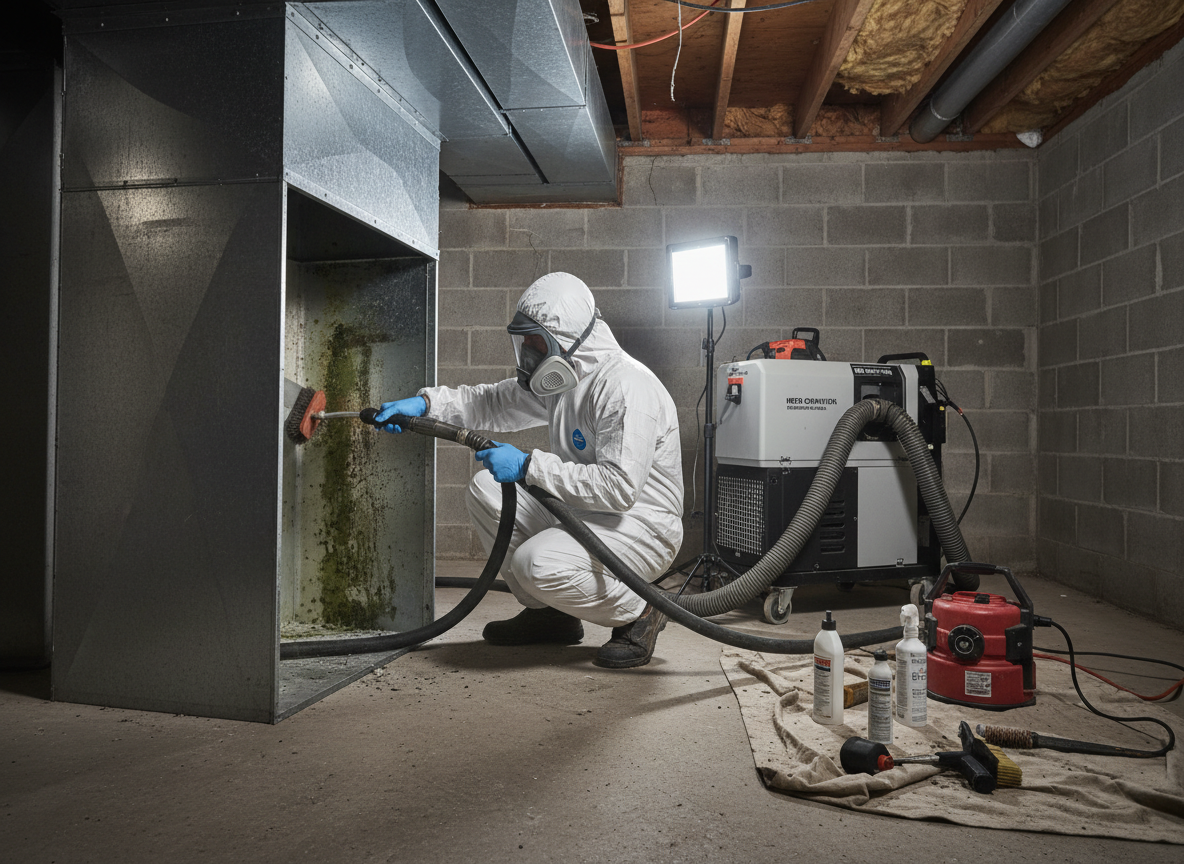
Franklin's older housing stock in Downtown Franklin often features narrow, uninsulated duct runs that trap moisture from spring snowmelt or summer storms. When water enters through roof leaks near the Franklin Opera House or foundation seepage along the Merrimack River corridor, mold colonies form inside supply lines and return plenums. Homeowners notice musty odors that worsen when the furnace kicks on after cold snaps. Proper removal requires accessing these tight spaces without spreading spores into living areas.
Cold winters followed by rapid thaws create repeated condensation cycles inside metal ducts, especially in homes built before modern vapor barriers. In neighborhoods around the Daniel Webster Birthplace, crawlspace ducts sit close to damp soil and pick up spores during flood events that reach Tilton or Laconia. Standard household vacuums cannot reach deep into elbows or trunk lines, so professional containment and HEPA filtration become necessary to prevent cross-contamination to adjacent rooms.
Merrimack County humidity spikes in summer can reactivate dormant mold if ducts are not fully dried after any water event. Technicians must verify that insulation inside ducts has not become a hidden reservoir, because replacing it often means opening finished ceilings in older Franklin properties. Skipping this step leaves residual moisture that returns the problem the next heating season.
Technician insight
In Franklin, the thing that catches most people out with Air Duct Mold Removal is how quickly snowmelt from the steep roofs around the Franklin Opera House finds its way into uninsulated attic ducts; once those lines stay damp through a single warm spell, mold blooms fast and homeowners keep running the furnace and spreading it.
Downtown Franklin Attic Ducts
Spring snowmelt leaked through an older roof seam and soaked supply ducts above the second floor. Camera inspection showed heavy mold inside the main trunk line feeding bedrooms. Containment was erected, the insulation was removed, and the metal was cleaned and treated before new insulation was installed. Odors disappeared and the system tested dry before the next cold front arrived.
Air Duct Mold Removal Services We Offer
✓Duct Inspection and Moisture Mapping
Camera scoping and moisture meter readings locate hidden mold colonies inside supply and return lines before any cleaning begins.
✓Containment and Negative Air Setup
Temporary barriers and negative air machines isolate duct runs so spores do not migrate into living spaces during removal.
✓HEPA Vacuuming and Brushing
Agitation tools combined with high-efficiency particulate air filtration pull mold and debris from duct walls without damaging metal seams.
✓Antimicrobial Application
EPA-registered treatments applied to cleaned surfaces inhibit regrowth in ducts that remain damp from Franklin's four-season climate.
✓Insulation Removal and Replacement
Wet or moldy duct insulation is cut out and replaced to prevent future moisture retention in older Downtown Franklin homes.
Air Duct Mold Removal Cost in Franklin, NH
| Service | Typical Range | What Affects It |
|---|---|---|
| Whole-home duct inspection | $150–$300 | Includes camera scoping and moisture mapping. |
| Standard air duct mold removal | $600–$1,200 | Typical for 1,500–2,000 sq ft homes with moderate growth. |
| Insulation replacement add-on | $250–$500 | Required when existing insulation is saturated. |
| Post-cleaning air quality sampling | $200–$350 | Optional third-party verification. |
Ranges are typical for Franklin, NH and confirmed with an exact written quote before any work starts.
How it works
- 1
Initial Assessment
Technicians arrive with cameras and meters to map moisture and visible mold throughout the duct system.
- 2
Containment Setup
Plastic barriers and negative air machines seal off work zones to protect the rest of the home.
- 3
Mechanical Cleaning
HEPA vacuums and rotating brushes remove mold and debris from every accessible section of ductwork.
- 4
Treatment and Drying
Antimicrobial agents are applied and fans run until all surfaces test dry before reassembly.
- 5
Final Verification
Post-cleaning inspection confirms mold levels are reduced and no residual moisture remains in the system.
Pricing
Pricing depends on the number of duct runs accessed, whether insulation must be replaced, and the extent of containment required in older homes.